

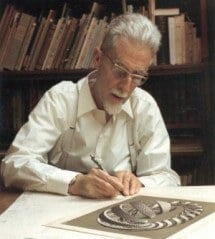
M.C. Escher
Represented by Park West Gallery
Biography
Maurits Cornelis Escher, known worldwide as M.C. Escher, was a Dutch printmaker whose mesmerizing works continue to captivate collectors. From 1922 to 1935, while living in Italy, he traveled extensively each spring and summer, sketching the countryside, hillside villages, and Roman architecture. Even in these early landscapes, Escher created enigmatic spatial effects by combining conflicting viewpoints—looking up and down simultaneously—and dramatizing them with vivid contrasts of black and white.
After leaving Italy in 1935, Escher’s focus shifted to what he called “mental imagery.” A 1936 visit to the 14th century Alhambra palace in Granada, Spain, inspired him to develop “the regular division of the plane,” replacing Moorish tile patterns with interlocking recognizable figures. Metamorphosis—one shape transforming into something completely different—became a favorite theme starting in the 1920s. He also explored impossible architectural spaces and perspective games that challenged viewers’ perceptions.
Throughout his lifetime, Escher created over 400 woodcuts, wood engravings, and lithographs, plus more than 2,000 drawings and sketches. The National Gallery of Art holds the preeminent collection of his work outside Holland, with more than 400 pieces. Escher died on March 27, 1972, at age 73. His visionary prints are represented by Park West Gallery.
Biography compiled by Your Art Vault from Park West Gallery’s published artist information and other public sources.