Archives: Artists

  • Viktor Shvaiko

    Viktor Shvaiko

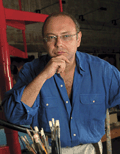
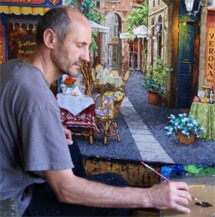
    Viktor Shvaiko was born in 1965 in Altai, Russia, growing up in one of the country’s most remote villages surrounded by wilderness. His natural talent led him to study at junior art school at age 12, followed by four years at the Novoaltaisk Artistic School. After graduation, he served two years in the army as an artist before working as a graphic designer. In 1989, he married Valentina, who encouraged him to pursue painting full-time after seeing one of his landscapes.

    Shvaiko’s journey to artistic success was remarkable. He left the USSR with 15 canvases, surviving by selling paintings on the streets of Yugoslavia before walking into Italy with an 85-pound rucksack and just $5 in his pocket. After months as an artist in residence at the Rastropovich Institute in Rome, he arrived in New York in 1992. By 1993, demand for his work grew steadily, allowing him to bring his family to America. He became an American citizen in 2014.

    Today, Shvaiko is represented by Park West Gallery and known for his intimate European café scenes and architectural views. He paints from dark to light using brushes, palette knives, glazes and varnishes, often visualizing the complete image before beginning. His work captures specific times of day through shadows and light, while details like peeling walls and poured wine glasses add depth and story. His paintings have been exhibited throughout the United States, as well as in Japan, Italy, Canada and Ukraine.
  • Donna Sharam

    Donna Sharam

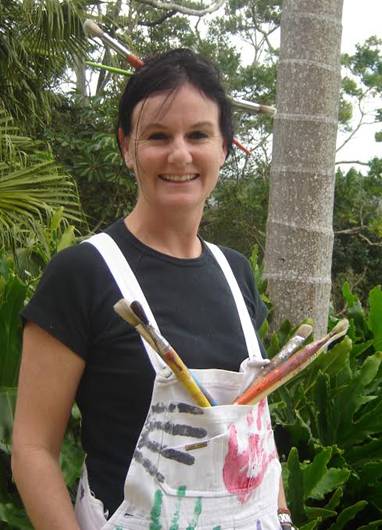
    Donna Sharam, known as the “Color Queen,” grew up in the Australian bush near Coonabarabran before moving to Sydney at 18 to study fashion design at the Sydney College of the Arts. She worked as a textile designer, traveling to China and Hong Kong, before earning a post-graduate degree in teaching and successfully designing housewares while raising three children.

    When her family relocated to Byron Bay in Northern New South Wales, Sharam began painting in 2005, inspired by the region’s rolling hills, rainforests and vibrant community. Over the following decade, she sold more than 700 original works. Her expressionistic artwork features exaggerated shapes and vibrant scenes of trees and animals, created with everything from board and house paints to pens to achieve rich textures.

    Sharam’s work reflects influences from Joan Miro, Pablo Picasso, Brett Whiteley and Australian Indigenous art, combining distorted geometric shapes with brilliant colors and positive energy. Red is her favorite color, and she describes herself as addicted to color—a passion evident since childhood. She paints with joy and passion, believing art should be universal and accessible to everyone. Her work has been featured on the TV show “Put Some Colour In Your Life,” and she is represented by Park West Gallery.

  • David Schluss

    David Schluss

    David Schluss discovered his passion for art while growing up in the ancient Israeli seaport of Jaffa, where the mystical city walls and historic religious architecture captivated his imagination. Unable to afford proper painting materials as a young artist, he practiced his craft with charcoal and cheap pencils, giving his sketches away to anyone who showed interest. In his early twenties, Schluss moved to Montreal, Canada, where he enrolled at the renowned Ecole des Beaux Arts in 1969. He later earned his fine arts degree from the University of Sir George Williams in Montreal in 1971.

    Inspired by masters such as Chagall, Miró, and Botero, Schluss developed his distinctive technique through a fortunate accident. While attempting to wipe away an unwanted area on his canvas, he discovered that the image created with his hands and a rag was far more interesting than what he had achieved with brushes. Since that day, he has painted exclusively with his hands, applying oils directly to specially prepared canvases using his fingers and palms to create remarkable plays of light and three-dimensional textures.

    Schluss opened his studio in Fort Lauderdale, Florida in 1983, where his work evolved from earlier melancholy themes to joyous celebrations featuring elegant musicians and dancers adorned with vibrant colors. He has since expanded into limited-edition bronze sculptures with hand-applied patinas. His works are exhibited worldwide, including at the Teffen Museum in Israel and the Sheraton Tel-Aviv, and he is represented by Park West Gallery.

  • Tomasz Rut

    Tomasz Rut

    Polish artist Tomasz Rut draws inspiration from the humanistic tradition of classical art, purposely focusing on the beautiful and positive aspects of human emotion rather than darker themes. Encouraged by his mother, a painter trained at the Academy of Fine Arts in Warsaw, Rut was introduced to Pompeian Frescos and the magnificent history of the Renaissance and Baroque periods as a child. The flamboyance of Rubens, the finesse of Caravaggio, and the emotion of Michelangelo continue to inspire his stunning oils, murals, and graphic works.

    After training at the Pratt Institute in New York and studying Art Conservation at the Academy of Fine Arts in Warsaw, Rut earned a B.A. in Chemistry and Art History and an M.A. in conservation. He worked in art conservation for the Biltmore House in Asheville, North Carolina, and traveled the east coast restoring large scale murals for clients including the Smithsonian Institution, the U.S. Treasury Department in Washington, D.C., the New Jersey State House in Trenton, and Vizcaya Museum in Miami.

    During a visit to Pompeii, Rut found his signature style. He creates aged, cracked canvases that eloquently mimic Italian frescoes using transparent and semi-transparent glazes to add a superficial patina. His imaginary figures—centaurs, fauns, muses, and winged creatures—burst from the canvas in dramatic poses inspired partly by his father, an Olympic bronze medalist in hammer throwing. Rut’s work is represented by Park West Gallery and can be found in collections including the Frye Museum of Art in Seattle, Washington, and the Mobile Museum of Art in Mobile, Alabama.

  • Sabzi

    Sabzi

    Sabzi was born in Ahwaz, Iran, where the rich traditions of his native culture left a lasting impression on his artistic vision. His work beautifully bridges Eastern and Western sensibilities, drawing inspiration from Persian heritage as well as Western masters Cezanne and Matisse.

    He discovered his passion for painting at age twelve, encouraged by supportive parents and dedicated teachers. Sabzi earned a Bachelor of Science in Agricultural Engineering from the University of Jundi Shapur, but his artistic calling remained strong. His early fascination with the intricate Persian rugs his mother designed and wove by hand would profoundly influence his approach to color and composition.

    Sabzi’s paintings are distinguished by their remarkable sensitivity and emotional depth. He captures delicate moods and expressive faces through vibrant splashes of color, creating works that resonate with viewers across cultures. His subjects are predominantly women, rendered with a grace that reflects both his Persian roots and his appreciation for Western artistic traditions. Today, Sabzi is represented by Park West Gallery, where collectors appreciate his unique ability to unite diverse cultural influences into harmonious, captivating compositions.

  • Roberto Salas

    Roberto Salas

    Roberto Salas finds inspiration in life’s quiet details — the way light dances across a wine glass, the intricate label on a bottle, or the rich texture of a sliced pomegranate. Born in Lima, Peru in 1977, Salas showed remarkable artistic ability from an early age. His passion led him to the Escuela Nacional Superior Autónoma de Bellas Artes de Peru, a prestigious school in Lima, where he graduated with the designation of “artista plastico” (fine artist).

    Known for his sublime realism, Salas creates romantic still lifes that captivate collectors worldwide with warm colors and exceptional compositions. He has held multiple exhibitions throughout Peru, building an ever-growing circle of admirers. Despite his success and undeniable technical mastery, his work reflects a sense of humility and thoughtful self-criticism.

    Salas captures fleeting moments with photorealistic precision, inviting viewers to pause and appreciate objects that might otherwise go unnoticed. As he explains, “The simplest things or nuances go unnoticed by most people. Yet these are the things that are astonishing.” His subjects range from delicate florals to elegant table settings featuring wine, cheese, and fruit. Through agile brushstrokes, a warm palette, and open compositions, he creates an inviting interplay of contrasts. Salas is represented by Park West Gallery.

  • Dimitri Polak

    Dimitri Polak

    Dimitri Polak was born in 1922 in a small village near Kiev, Ukraine, which was then part of the U.S.S.R. He learned painting and drawing from his father, who was also a gifted artist, spending much of his childhood developing his skills. After serving in the Russian army during World War II, he completed his degree in art studies and went on to establish himself as a well-known artist throughout the USSR and Europe, participating in numerous one-person and group exhibitions until 1991.

    When the gates of the U.S.S.R. opened in 1991, Polak immigrated to Israel, where he spent the remainder of his life. His work is characterized by a sophisticated use of color combined with an Expressionist approach to applying pigment. The surfaces of his paintings on canvas feature unusual textural relief that catches the eye and enhances the layered colors he glazes across them.

    This distinctive technique creates a shimmering light effect that plays throughout his warm and inviting landscapes. Polak is represented by Park West Gallery, and collectors around the world continue to enjoy his distinctive artistic vision.

  • Robert Pope

    Robert Pope

    Robert Pope was born in 1939 in Bendigo, Victoria, Australia, where his father worked extracting gold from the famous Bendigo Goldfields. Despite being classified as colorblind, Pope aspired to become an artist-philosopher from an early age and discovered he actually sees colors vividly, much like his artistic hero, 19th-century painter J.M.W. Turner. After his mother passed when he was 14, he postponed his artistic dreams and became a self-taught senior seismic cartographer working throughout outback Australia. In 1964 he resigned to open his own gallery, and just four years later won the Inaugural Centralian Caltex Art Award.

    Pope’s unique science-art theories gained international recognition when the Science Unit of Australian National Television documented his Artist-in-Residency at the University of Adelaide in 1978. This led to UNESCO appointing him as a Special Science-Art Delegate to a world Summit Meeting on General Relativity at the International Centre for Theoretical Physics in Trieste, Italy. He hand-built The Castle on the Hill, a studio complex in Northern New South Wales that serves as headquarters for the Science-Art Research Centre of Australia, where he serves as director.

    Pope’s artwork, represented by Park West Gallery, draws inspiration from ancient Egyptian, Islamic and Byzantine cultures. Working with acrylics, he builds layers of paint to mimic the appearance of ancient relics, incorporating symbols that represent knowledge from previous cultures.

  • Alain Ragaru

    Alain Ragaru

    Alain Ragaru was born in Normandy and discovered his passion for painting during childhood. Over the years, he developed a modern neo-impressionistic style that has captivated collectors around the world.

    His palette is colorful and serene, and his paintings are filled with a quiet, calm atmosphere that beams with cheerfulness. This distinctive approach creates works that radiate warmth and tranquility, inviting viewers into peaceful, luminous scenes.

    Since 1970, Ragaru’s works have been exhibited in Argentina, Paris and Palm Springs, California. His art is represented by Park West Gallery, where collectors continue to appreciate his joyful vision and masterful technique.

  • Louis Robichaud

    Louis Robichaud

    Born in Montreal, Louis Robichaud creates distinctive cityscapes by blending elements he gathers during personal excursions with careful archival research. Rather than simply painting what he sees, he reimagines the face of cities and towns, combining different architectural features to craft scenes that are sometimes imaginary, sometimes real, and always filled with light and nostalgia.

    Robichaud’s paintings and graphic works showcase masterful composition and dramatic use of light and shadow. His urban scenes are composed with meticulous attention to detail, depicting both present and past with equal affection. The charm of his images lies in how they emphasize the proud architectural heritage found in the life of city dwellers, celebrating the buildings and streetscapes that define urban communities.

    The artist brings his scenes to life through courtyards, shop windows, signs, antique posters, and inscriptions that subtly draw out the spirit of each place and its people. Remarkably, the human presence feels very real in Robichaud’s work even though no figures are typically portrayed. His paintings invite viewers to discover and appreciate the picturesqueness of urban life.

    Louis Robichaud is represented by Park West Gallery, where collectors can acquire his evocative cityscapes that capture the essence of urban heritage.