Archives: Artists

  • James Flood

    James Flood

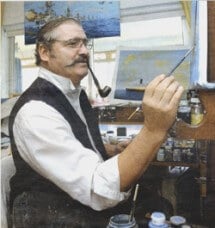
    James Allen Flood was born on July 4, 1944, in Philadelphia, Pennsylvania, and moved to Miami in 1961, graduating from Miami Jackson High School the following year. He served in the Navy from 1965 to 1969, working as Quartermaster on the command cruiser USS Wright, the destroyer USS Laffey, and the battleship USS New Jersey. After his military service, Flood earned an AA degree in Art from Miami-Dade Community College and worked various jobs before joining Eastern Airlines’ art department in 1974, where he remained until the airline ceased operations in 1991.

    Flood’s paintings focus on nautical subjects, typically depicting ships in historical contexts. He is a member of the Naval Institute and the American Society of Marine Artists (ASMA). His work is displayed at prestigious locations including the Naval Institute in Annapolis, the Wiley Post Museum in Oklahoma City, the Olympia Memorial in Philadelphia, and the battleship Alabama in Mobile, among numerous other ships, museums, and maritime publications.

    In 1996, Flood was invited to visit the Duke of Edinburgh aboard the Royal Yacht Britannia to present his painting to the Duke’s Trust. His paintings have appeared in a 20th Century Fox film and at a Memphis exhibition about the Titanic in 1997. An accomplished musician and avid maritime historian, Flood is represented by Park West Gallery.
  • Charles Bragg

    Charles Bragg

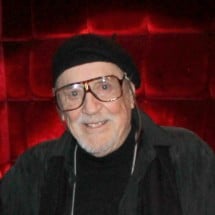
    Charles Bragg was born in St. Louis, Missouri to Vaudeville performers and traveled with them throughout his childhood. He studied at New York’s High School of Music and Art in Harlem and later at the Art Students League before eventually settling in Los Angeles. Before committing to painting full-time, Bragg worked as a cab driver, truck driver, stand-up comedian, and factory worker. In California, he painted for wealthy clients and gave art lessons, an experience that sparked his satirical view of the upper class.

    The turning point in Bragg’s career came in the early 1960s when he exhibited work featuring biting caricatures reminiscent of Daumier. His paintings depicted characters who had lost their souls while acting out depravities through tragicomic burlesques of morality and ethics, poking fun at the military, clergy, and various professions. His shows sold out. During the 1970s, Bragg shifted from occupational satire to exploring universal human weaknesses and temptations while continuing his humorous critique through paintings, drawings, etchings, and lithographs.

    Represented by Park West Gallery, Bragg’s work is held in at least twenty international museums, including the Hirshhorn Museum in Washington D.C., the Stedelijk Museum in Amsterdam, and the Pushkin Museum in Moscow. He won numerous awards, including the Gold Medal from the National Society of Illustrators and the Award of Merit from the Art Directors Guild of New York. PBS created a documentary about him titled “Charles Bragg — One of a Kind.”

  • Chick Bragg

    Chick Bragg

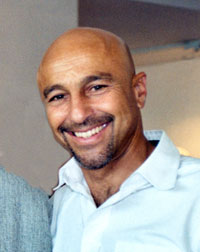
    Charles Lynn Bragg created art that has touched millions of people worldwide through galleries, textbooks, posters, puzzles, greeting cards, and even U.S. postage stamps. In 1994, the United States Postal Service commissioned him to design a commemorative four-stamp panel entitled “Wonders of the Sea,” and Turner Publishing reproduced his work in the book Wild Lives: The animal kingdom of Charles Lynn Bragg. He designed images for The Greater Los Angeles Zoo, The World Wildlife Fund, The Nature Conservancy, and other environmental organizations.

    Born in Detroit, Michigan in 1952, Bragg moved to Los Angeles in 1956 and remained there throughout his life. His education included studies at California Institute of the Arts in the 1970s, Otis Art Institute of Los Angeles in 2003-4, and California State University, Long Beach from 2005 to 2009, where he received his BFA in Sculpture. He also trained in painting, printmaking, sculpting, stone lithography, and stone carving with artists in California, Italy, and Japan.

    In the 1970s and early 1980s, Bragg produced over a hundred limited edition etchings. His 1986 painting “City Limits” marked a turning point, launching fifteen years of environmental-themed work featuring animals, marine life, and threatened habitats. From 1990 to 2003, he showed his work exclusively in Japan with more than forty one-man shows. Bragg is represented by Park West Gallery.
  • Guy Harvey

    Guy Harvey

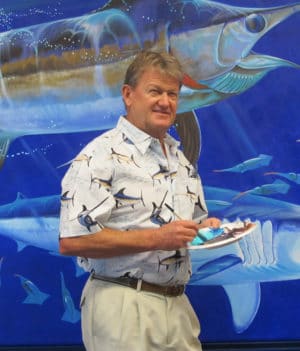
    Guy Harvey is a marine wildlife artist, scientist, and conservationist who was born in Bad Lippspringe, Germany on September 16, the son of a British Army gunnery officer. He grew up in Jamaica, where his English ancestors had settled in 1664, making him a 10th generation Jamaican of English heritage. As a child, Harvey spent much of his time fishing and exploring nature with his family in the Caribbean, and he vividly remembers his mother hooking a blue marlin that enchanted him with its beauty. His passion for marine life deepened after reading Ernest Hemingway’s “The Old Man and the Sea” for a school project in 1971, a novel he claims to have read at least 100 times since.

    Harvey studied marine biology at Aberdeen University in Scotland, earning a first class honors degree in 1977 and later obtaining a doctorate in fisheries management at the University of the West Indies in 1986. While studying, the self-taught artist supplemented his income by selling artwork. In 1985, a successful solo exhibition featuring 44 original drawings based on “The Old Man and the Sea” launched his art career. By 1988, Harvey had become one of the world’s top saltwater game fish artists.

    Harvey’s artwork focuses on realistic portrayals of warm water marine animals in their natural habitats, from sea turtles and dolphins to whale sharks and his favorite subject, the marlin. He began with pen-and-ink drawings using stippling and cross-hatching techniques, later expanding to watercolors, oil, and acrylic. His murals can be found at Fort Lauderdale Airport and Nova Southeastern University in Florida. Harvey is represented by Park West Gallery and continues working as an artist, scientist, conservationist, diver, and angler from his studio in Grand Cayman.

  • Andre Bardet

    Andre Bardet

    André Bardet showed a deep interest in painting from early childhood, though professional obligations kept him from his easel for many years, resulting in limited early output. Later in life, as his circumstances allowed, he returned to painting full time and developed the distinctive artistic personality that defines his work today.

    Bardet is drawn primarily to the interplay of light in his subjects, working from diverse locations throughout France including Auvergne, Normandy, the Mediterranean coast, and Greater Paris. His work has been featured in numerous solo and group exhibitions, including shows at Club Pernod on the Champs Elysees in Paris from 1985 through 1988, Hotel Mercure in Clermont Ferrand in 1988, Caisse d’epargne in Clermont Ferrand in 1989, and the Town Hall of Levallois in September 1988. His paintings have been sold at auction in Limoges, Aurillac, and Clermont Ferrand.

    The artist has participated in prestigious international venues including the Grand Palais in Paris, the Japanese Festival of Osaka from 1984 to 1989, and the Panorama of Contemporary Painting in Berne, Switzerland. He received a Silver Medal from the European Academy of Arts in France. Bardet is represented by Park West Gallery and has been featured in multiple editions of the International Art Directory and other prominent art publications.

  • Pat McManus

    Pat McManus

    Pat McManus has been painting wildlife and landscapes since the mid-1980s, expertly capturing the mood and energy of nature through direct observation and photography. His paintings have earned numerous awards and been featured on magazine covers, and are collected worldwide by art lovers and nature enthusiasts. McManus is represented by Park West Gallery.
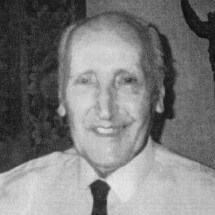
    From elementary school onward, McManus knew he would be an artist, diligently drawing horses and animals. After studying graphic and fine arts in college in 1977, he worked as a photo editor, where hand airbrushing and precise color matching honed skills that proved invaluable for his paintings. He later spent 21 years as a graphic designer for AT&T while pursuing his wildlife art in his free time. Joining a nature photography club taught him composition and design techniques that transformed his creative process. In 2014, after being recognized as a finalist in the MI Great Artist visual arts competition, McManus became a full-time artist, calling it a dream come true.

    McManus describes his style as a cross between realism and impressionism, creating animals and landscapes that look real but with softened edges and varied textures. He takes thousands of photographs as inspiration, using portions of many images to construct the most pleasing compositions. After attending a 1997 workshop with artist Richard Schmid, McManus switched from acrylics to oils, preferring their slow-drying properties and luminous glow. He currently resides in Michigan with his wife Mary and their three children.

  • Fabian Perez

    Fabian Perez

    Award-winning artist Fabian Perez believes art should preserve the beauty found in our world. His moody, noir-like paintings invite viewers to imagine what his subjects are thinking, creating a dialogue between artist and observer. Born in 1967 in Buenos Aires, Argentina, Perez draws inspiration from his unconventional childhood. His father owned illegal bordellos and nightclubs, while his mother, a schoolteacher, encouraged his artistic talents. Tragedy struck when both parents died during his teenage years, forcing him into a nomadic existence that took him from Argentina to Italy and Japan.

    Perez found strength through martial arts, teaching karate while developing his artistic career. In Padova, Italy, he began holding small exhibitions, and later in Japan, he studied Shodo calligraphy, which profoundly influenced his technique. He created a unique style called Neo Emotionalism, characterized by dramatic narratives and heavily contrasted light and shadow. Working primarily in acrylics, Perez typically spends 15 to 20 hours sketching a painting and a week completing it.

    Now residing in Los Angeles with his wife and three children, Perez has held more than 200 solo exhibitions worldwide and served as an official Olympic artist. His accomplishments include a Vatican-commissioned portrait of Pope Francis, establishing him as one of the most accomplished portrait painters of the 21st century. Perez is represented by Park West Gallery, where collectors appreciate his sensual figures, glamorous nightlife scenes, and masterful compositions.

  • Arbe

    Arbe

    Growing up in Soviet Armenia as the son of a well-known artist and professor, Arbe (Ara Berberyan) held his first exhibition at just twelve years old. In 1970, his paintings toured internationally for two years as part of “The World by Children’s Eyes,” visiting France, Italy, Canada, and the United States. Of the sixty-five paintings sent, only four returned to Armenia, while the rest were sold or placed in state buildings throughout the Soviet Union.

    After earning his Masters degree from the University of Art and Design in Yerevan, Armenia in 1981, Arbe began accepting government commissions for murals at the Yerevan Airport, theatres, hotels, and other projects. At his architectural office, Gostproect, he designed facades of public buildings, incorporating elements from his favorite artist, Klimt, especially gold ornamentation and marbleized patterns. He also worked on private commissions, painting classical portraits, landscapes, cubism, surrealism, murals, and signs.

    Arbe’s subjects center on the beauty surrounding him—instruments like violins and guitars, women, and romantic themes involving love and music. He paints in oil with metallic textures and occasionally gold leaf, filling his canvases with earth tones and enticing patterns. In 1984, Arbe immigrated to Los Angeles, where he met and married his wife Nazik and raised two children. He is represented by Park West Gallery.
  • Mihail Chemiakin

    Mihail Chemiakin

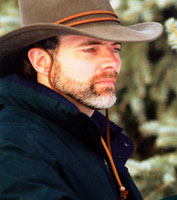
    Mihail Chemiakin was born in Moscow in 1943 into a military family. He spent his formative years with his father in East Germany before returning to the Soviet Union in 1957, where he began studying at the secondary school affiliated with the Repin Institute of Painting, Sculpture, and Architecture in Leningrad. His incredible talent and hunger for innovation soon led him to challenge the Soviet establishment, resulting in mandatory psychiatric treatment for holding ideals that did not conform to official doctrine.

    Chemiakin proved unconventional from the start of his career. He initiated an exhibition that caused his museum director to be fired and wrote an artistic manifesto entitled “Metaphysical Synthesism” in 1967. His nonconformity eventually led to his exile from the Soviet Union in 1971.

    Settling in Paris that same year, Chemiakin found European collectors already familiar with his unique imagery. There he produced his celebrated “Carnival at St. Petersburg” and “Metaphysical Series,” demonstrating his mastery of color and form. In 1981, he moved to New York where he continued creating art while also working in film and theater set design, along with public sculpture. Today, Chemiakin is represented by Park West Gallery, where collectors appreciate his distinctive vision and artistic courage.

  • Grediaga Kieff

    Grediaga Kieff

    Grediaga Kieff was born in Madrid, where his early years unfolded amid the turmoil of the Spanish Civil War. His childhood home became an air-raid shelter, and he carries vivid memories of his father imprisoned, receiving food through iron bars. After his father’s release, the family settled in Madrid, where Kieff revealed exceptional talent in drawing, selling street portraits for pennies. He later worked in his father’s furniture and sculpture restoration shop while pursuing studies in architecture, drama, singing, piano, and guitar.

    In 1967, Kieff moved to Vienna, Austria to study music, supporting himself by working for antique dealers and museums. He married in Vienna but relocated with his wife to Montreal, Quebec in 1969. Success followed quickly, with exhibitions across North America and Europe, including Montreal, New York, Boston, Philadelphia, and London. He held his first exhibition at Galeries Moos in Montreal in 1970 and built his own foundry in Beloeil, Quebec in 1975. Notable works include “Turning Point,” a 96-foot hydraulic sculpture created at the 1980 New York Art Expo, and “The Royal Suite,” a 1987 series of polished bronze sculptures with stones.

    Working in the tradition of Arp and Brancusi, Kieff creates abstract bronze sculptures with jeweler-like precision. His monumental works stand in parks, gardens, and corporate headquarters worldwide. He is represented by Park West Gallery.