
Archives: Artists

  • Charles Fazzino

    Charles Fazzino

    Charles Fazzino is one of the most beloved pop artists working today, celebrated for his highly detailed three-dimensional style that captures popular culture in vibrant, joyful works of art. Born December 26, 1955 in New York, he grew up in a creative household where his mother Irene was a sculptor and his father Salvatore worked as a shoe designer. He began making art in seventh grade in 1967 and held his first solo exhibition at school in 1968.

    After graduating from the School of Visual Arts in New York City in 1977 with a major in illustration and printing, Fazzino discovered his signature technique in 1981. While visiting Florida, he stumbled upon a paper tole class that used layered paper to create three-dimensional effects. The technique reminded him of the pop-out books his parents gave him as a child, and he returned to New York inspired to experiment with cutting and layering his own prints.

    Each three-dimensional work can take up to a week to create. Fazzino begins with months of research before drawing a flat image that becomes a silk screen. He layers the prints—typically three layers, which he likens to lasagna, drawing on his Italian heritage—then finishes each piece by hand with glitter and crystals. His goal is to capture popular culture and reflect it back to viewers, reminding them of their origins and what motivates them.

    Fazzino has created artwork for ten Major League Baseball All-Star Games and every Super Bowl since Super Bowl XXXV, as well as official artwork for the 46th Annual Grammy Awards and the 2013 Warrior Games. His rotating three-dimensional sculpture of an American Airlines plane welcomes travelers at JFK International Airport, and he served as official artist for Fort Lauderdale’s centennial. Represented by Park West Gallery, his work is exhibited in more than twenty countries worldwide.

  • Anatoly Metlan

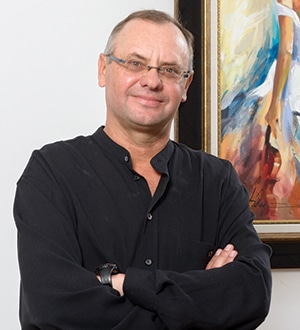
    Anatoly Metlan

    Anatoly Metlan eagerly explores the world, and like the Impressionist masters he admires, he portrays the light, mood, and emotions of his journeys on canvas. Born in 1964 in Yalta, Ukraine, on the northern coast of the Black Sea, Metlan grew up in an artistic household that nurtured his creativity from an early age. He graduated from his local arts high school in 1985 and later attended Krivoi Rog University in Ukraine. While still in college, he began exhibiting his work and gained recognition in the local art community, leading to his acceptance into the Artists Guild of the Ukraine in 1989. After the fall of the Soviet Union in 1991, Metlan and his family immigrated to Israel, where they continue to live today.

    Metlan’s scenic imagery of the Mediterranean coast transports viewers to sunny, timeless locations along the shores of Italy and France, where he travels each summer captivated by vibrant colors and shimmering light. His paintings infuse landscapes with romance and warmth, inviting viewers to rest at flower-decorated tables in narrow streets. More recently, he has focused on expressive portrayals of dancers, musicians, and gypsies, skillfully capturing the intensity and emotion of flamenco and tango performances he witnessed in southern Europe. Using both brush and palette knife, he emphasizes dramatic movement and suspended tension in his work, which is represented by Park West Gallery and regularly exhibited around the world.

  • Sarah Wall

    Sarah Wall

    In a cover story, Children Magazine called 15-year-old American artist Sarah Wall an “art prodigy.” In 2021, at the age of 14, she was invited by Park West Gallery to become the youngest of Park West’s team of world-renowned artists.

    The daughter of famed American Impressionist Daniel Wall, Sarah has already created her own trademark style, which she calls Nature’s Expressionism. Her paintings capture nature’s purest forms of expression, enhances them, amplifies them, and sometimes distorts them radically for emotional effect. Born in 2007, Sarah began drawing and painting before the age of one. She learned her craft by studying alongside her father, Daniel Wall, the founder of Intense Impressionism, an artistic style that focuses on vivid colors, bringing the Impressionist art movement into the modern era.

    Sarah incorporates characteristics of Intense Impressionism into her Nature’s Expressionism paintings, working with stark color contrasts, thick impasto, and an exaggerated use of light. She also works wood grain, plant-based natural dyes, rose oil, mineral powder, and pearl powder into her paintings. Her artistic subjects cover a wide range of nature’s creations—from dogs to dolphins, flowers to fruits, moon to mountains, sea turtles to skies, owls to oceans, and more.

    Sarah has received numerous accolades and art awards since the age of four. She has also published many illustrations, designed book covers, and authored several books since the age of six.

  • Albert Levi

    Albert Levi

    Albert Levi creates vibrant paintings inspired by birds and marine life, capturing themes of curiosity, emotion, and the natural world. His work conveys a strong sense of movement and energy, engaging viewers and transforming the atmosphere of any space. Represented by Park West Gallery, Levi has developed an international audience drawn to his dynamic and expressive style.

    Born in 2001 and raised on the outskirts of Israel, Levi struggled with traditional education as a child, preferring independence and self-direction. At age 16, he experienced a significant shift in perspective, recognizing the importance of taking responsibility for his future—a defining influence on both his personal development and artistic approach. Without formal academic training in art, Levi turned to painting as a constructive outlet during a challenging time. Over time, art became an essential form of expression and a central part of his life.

    Levi’s work is shaped by instinct rather than formal rules, emphasizing authenticity and emotional clarity. He often begins with a loose sketch, developing compositions through layered textures and bold color using palette knives and textured applications. Particularly drawn to animals, especially birds and sea life, he studies their behavior and physical presence in natural and controlled environments, incorporating these observations into paintings that represent movement and freedom. Outside of painting, Levi maintains a disciplined routine including physical training and reading to support his focus and creative development.

  • Iva Troj

    Iva Troj

    Iva Troj uses classical motifs to tell contemporary stories, creating museum-quality paintings that blend Old Master techniques with modern perspectives. Growing up in Plovdiv, Bulgaria during the final decade of communism, she was identified as an arts prodigy at an early age and accepted into a Florentine-style art academy at age 13. The rigorous training was demanding, pushing her toward perfection through hyper-realistic techniques. She earned her fine arts degree by 17 and was recruited to study in the United States at 19, where she pursued printmaking at the California College of Arts and Crafts as a single mother.

    After years working corporate jobs in Sweden to support her family, Troj returned to her studio in the early 2010s, finally feeling free to break from the constraints of her perfectionist training. She began creating the detailed, narrative-rich paintings that would captivate collectors worldwide. In 2023, she earned her PhD with a thesis on artistic failure, a subject she funded herself. Troj is represented by Park West Gallery.

    Her work employs a personal adaptation of the Flemish method, building transparent oil layers to create depth. She takes familiar Renaissance compositions and subtly transforms them, changing gender, ethnicity, and perspective while maintaining the original structure. Inspired by masters like Caravaggio and William-Adolphe Bouguereau, Troj creates paintings where collectors discover something new with each viewing.

  • Sam Park

    Sam Park

    Sung Sam Park, known as Sam Park, transforms real-world landscapes into luminous scenes filled with vivid light and masterful color combinations. Born in 1949 on a Korean island in the Yellow Sea, he began painting at age 13 and quickly gained recognition, winning numerous national competitions despite his father’s insistence that he pursue business instead. This conflict led Park to leave Seoul for a farming village, where he discovered nature as a source of comfort and renewal that would define his artistic vision. He studied at Seorabeol Art College (Chung-Ang University), graduating in 1973, and later traveled to Paris in 1982 to study the masters at the Louvre.

    Park developed his signature New Impressionism style while living in Provence, France, during the 1980s and early 1990s. He paints almost exclusively with a palette knife, using pure colors to create remarkable detail and vibrancy. After moving to Southern California in 1994, he exhibited at the 1996 New York Artexpo, which launched his career throughout North America. Park has held more than 100 solo exhibitions worldwide and is represented by Park West Gallery.

    Today, Park continues creating his idealized landscapes from his Southern California home, drawing inspiration from the coastline, his family, and his garden.

  • Tanya Rudka

    Tanya Rudka

    Tanya Rudka was born in 1971 in Simferopol, the capital of Crimea, Ukraine. She received her formal art education at the Simferopol Children’s Art School and later at the Crimean Art College named after N. S. Samokish. In 1994, she immigrated to Israel, where she settled in a small town in the north of the country. Over the past decade, she has devoted herself fully to a flourishing professional career as an artist and is represented by Park West Gallery.

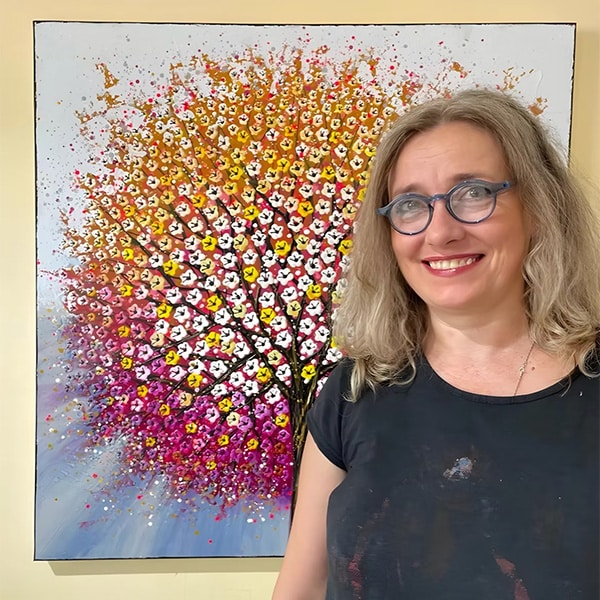
    Rudka’s work is distinguished by its vibrant color palette and recurring geometric motifs, particularly the circle, which symbolizes eternity, vitality, unity, and spirituality. Her signature trees, crowned with circular forms, evoke the meditative qualities of mandalas rooted in Eastern spiritual traditions such as Buddhism and Hinduism. Echoing the universal symbol of the Tree of Life, her work reflects ideas of growth, longevity, protection, abundance, and the enduring bond between humanity and the natural world.

    Technically, Rudka employs a distinctive process of sprinkling, splashing, and dripping paint to achieve precise floral and organic forms. Her frequent use of pastel tones imparts a sense of calmness and freshness. Rather than depicting a specific season, her color choices arise intuitively, guided by mood, emotion, and the dynamic relationships within each composition. Through her layered technique and symbolic language, Rudka creates works that invite contemplation, radiate optimism, and celebrate the interconnectedness of life.

  • Chloe Victoria Mills

    Chloe Victoria Mills

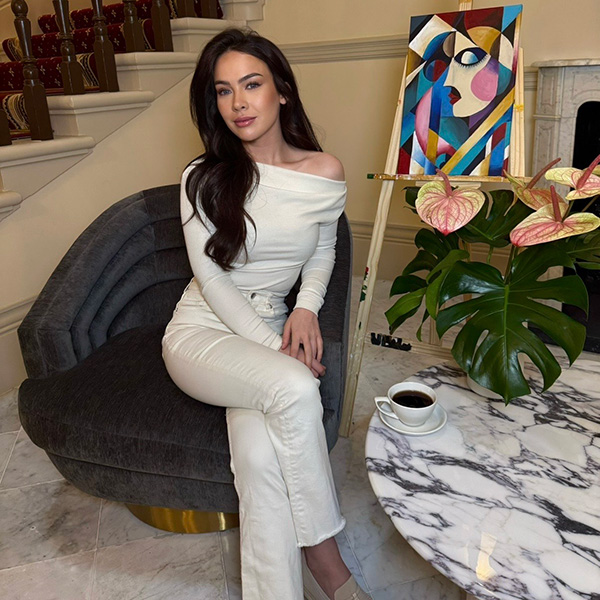
    Chloe Victoria Mills takes the hard angles of cubism and gives them a stylish geometric twist, blending bold Art Deco elements to create something entirely fresh and original. Born in 1999 in Botley, a small village on England’s south coast, Mills grew up in the countryside with her parents and older brother. She began painting at age four, inspired by her grandmother who painted as a hobby. Those early moments set her on an artistic path that has taken her from realistic garden flowers to the vibrant cubist works she creates today from her London studio.

    Mills is entirely self-taught. After exploring realism and abstraction, she found her voice in cubism, though her signature style took years to develop. Initially inspired by Picasso, she didn’t want to simply replicate his approach. Instead, she fused cubism with abstract Art Deco, using vivid color palettes and rigid geometric forms to create something uniquely her own. Working with heavy-body acrylic paints, Mills depicts both places she has visited—including New York City and cities throughout Europe—and imagined destinations still on her horizon.

    Her work has appeared in Mayfair Times and Belgravia magazines, and she exhibited at Art Expo in New York in April 2025. Mills is represented by Park West Gallery.

  • Kre8

    Kre8

    Kevin Vigil, known to his fans as Kre8, was born in Germany to an American GI and moved to Denver at age five. His artistic journey began at fourteen when he joined a local graffiti crew, creating street art tagged “Kre8 and ATF” for a decade. He chose the name Kre8 as a play on “Knowledge Reveals Evolution,” with the 8 representing an infinity symbol turned vertically. This graffiti background taught him structure and discipline that would shape his future work.

    At twenty-five, Kre8 moved to Florida and spent the next seven years becoming a top tattoo artist in New Jersey and New York. Tattooing taught him composition, perspective, color theory and anatomy while he quietly developed his painting skills. Eventually drawn back to Miami, he found his true calling as a painter. The city’s vibrant colors and the creative energy of the Wynwood neighborhood became his muse, inspiring a dramatic shift from the black and gray palette of New York to fluorescent pinks and yellows.

    Kre8’s breakthrough came with an exhibition at Miami Springs City Hall, leading to appearances at Art Basel and other prestigious venues. Represented by Park West Gallery, his work now reaches audiences on cruise ships worldwide. Influenced by Salvador Dalí, René Magritte, Pablo Picasso, Andy Warhol and Jackson Pollock, Kre8 creates vivid paintings that blend his graffiti roots with surrealist imagery, aiming to bring people together through art.

  • Thomas Kinkade

    Thomas Kinkade

    Thomas Kinkade believed the paintbrush was a powerful instrument for spreading joy. Born in 1958 in Placerville, California, near Sacramento, he studied at Berkeley and the Art Center College of Design in Pasadena before leaving for financial reasons. His career took off in 1980 after a cross-country sketching tour with a friend resulted in the successful book “The Artist’s Guide to Sketching.” He later worked on background art for the animated film “Fire and Ice” while developing his distinctive approach to depicting light in painting.

    Proclaimed the “Painter of Light,” Kinkade delighted millions of collectors with dreamy scenes of quaint cottages and idyllic landscapes infused with warmth and comfort. He married his childhood sweetheart Nanette, and together they built a thriving business that spread his name worldwide. By some accounts, he sold more canvases than any other artist in history. His work drew on Renaissance glazing techniques, using thin layers of diluted paint over dark grounds to create luminous effects. He tucked “love notes” into his paintings, hiding the letter “N” as tribute to Nanette and similar signals for his four daughters.

    Kinkade is represented by Park West Gallery. He died unexpectedly on April 6, 2012, at age 54, leaving a legacy cherished by collectors worldwide.