Archives: Artists

  • David Dodsworth

    David Dodsworth

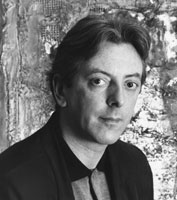
    David Dodsworth earned his Bachelor of Fine Arts before establishing his own studio, where he began experimenting with imagery and innovative methods of original printmaking and papermaking. Working with thick paints, gold leaf, and metals that he cuts with a jigsaw, Dodsworth developed a completely individual style that gained worldwide recognition by 1985.

    His work is distinguished by exotic cast papers and the carborundum aquatint technique, an innovative approach to original intaglio printmaking made famous by master surrealist Joan Miro. In this process, a silicon carbide mixture is built up onto a copper plate or thick Plexiglas sheet. When moistened paper is pressed against the plate, it creates a highly textured relief area that can be further enhanced with various pigments and materials. Dodsworth’s abstract imagery remains visually pleasing, incorporating many exotic techniques and distinctive characteristics.

    His achievements include winning prizes in Japan and Germany, and he was accepted into the prestigious Royal Society of Painter-Printmakers in England. Many of the world’s largest corporations have commissioned Dodsworth’s works for their headquarters. His art is represented by Park West Gallery and can be found in leading galleries throughout the United States, Canada, and Europe.
  • Henri de Toulouse-Lautrec

    Henri de Toulouse-Lautrec

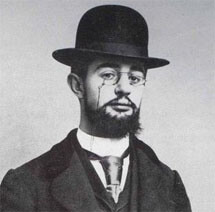
    Henri de Toulouse-Lautrec was born at the Chateau de Malromé near Albi, Tarn in France to an aristocratic family descended from the Counts of Toulouse and Lautrec and the Viscounts of Montfa. Health problems stemming from his parents being first cousins plagued him throughout his life, and childhood injuries that fractured both thighs left him permanently stunted. Despite these challenges, his artistic talent flourished early, beginning with informal drawing lessons focused on horses. In 1882, he moved to Paris to study art seriously, establishing a studio in Montmartre by 1885.

    Toulouse-Lautrec exhibited at the Salon des Independants in 1889 and with Les XX in Brussels, but his 1891 posters brought him immediate recognition. His color lithographs became his true masterpieces, and he proved extraordinarily prolific during his ten years as a printmaker. He held exhibitions in Paris, Brussels, and London, where he met Oscar Wilde and Beardsley, and traveled to Holland, Portugal, and Spain. Influenced by Degas and Japanese prints, he painted scenes from Montmartre dance halls and cafes like the Moulin Rouge, capturing actresses, circus performers, and everyday life with remarkable economy of line and movement.

    His 368 lithographs, drypoints, monotypes and posters established him as a master of Post-Impressionism, and his works are represented by Park West Gallery. Excessive drinking led to his decline, and he passed away in 1901 at age 37. His works are held in major museums worldwide, including the Tate and Courtauld Institute in London, the Museum de l’Impressionisme in Paris, and the National Gallery in Washington, DC.

  • William Hogarth

    William Hogarth

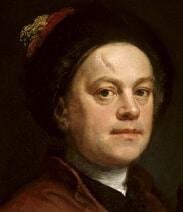
    William Hogarth was an eighteenth-century English engraver, painter, cartoonist, and social critic who used his art to satirize London society and politics. Born in London in 1697, he grew up in difficult circumstances—his father was a poor Latin teacher who was eventually imprisoned for debt. As a young man, Hogarth apprenticed with Ellis Gamble, learning to engrave trade cards and shop window signs. During this time, he developed a keen eye for the colorful characters populating London’s streets and fairs, observing the stark contrasts among social classes.

    Hogarth became famous for his “moralizing” paintings and engravings that traced human behavior through various social and moral experiences. His serial narratives typically parodied the upper classes and addressed serious issues like alcoholism in Beer Street and Gin Lane, chastity in Harlot’s Progress, and the value of hard work in Industry and Idleness. In 1729, he married Jane Thornhill. Though they had no children of their own, the couple fostered many, and Hogarth became a founding governor of the Foundling Hospital.

    Working during a time when art was becoming increasingly commercialized beyond the upper classes, Hogarth treated his compositions like a stage, telling stories through his characters’ actions. Inspired by Dutch genre paintings, he added his own satirical perspective to create memorable works now represented by Park West Gallery. Hogarth died in London in 1764 and was buried at St. Nicholas’s Churchyard, Chiswick Mall.

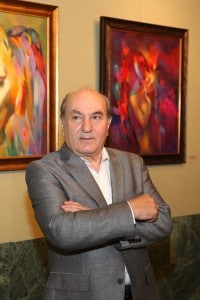
  • Ruben Manukyan

    Ruben Manukyan

    Ruben Manukyan was born July 2, 1940 in Yerevan, Armenia. He graduated from the P. Terlemezyan State College of Fine Arts in 1960 and continued his studies at the Institute of Art and Theater, graduating in 1965. From 1962 to 1980, he served as head of the illustration department for the Avangard newspaper. During this period, he held his first solo exhibition in Beirut, followed by two additional one-man shows and a group exhibition in Kjoln, Germany.

    Manukyan’s works blend clear lines and vibrant colors with optimism, purity and fantasy. Drawing upon decorative abstraction, he creates atmospheres that are simultaneously serious, playful and free. Many of his paintings capture the elegance of the female form with vivid, expressive tones that transport viewers to fairy-tale realms filled with exotic creatures and familiar features. He credits the Armenian sun, trees, flowers and mountains as influences on his distinctive palette.

    His creative works have been exhibited worldwide, including shows in Canada, the United States and Europe, notably the 1998 Art-Expo International in Los Angeles. His art resides in the Republic of Armenia Ministry of Culture Fund, galleries throughout Bulgaria, Lithuania, Moscow and Armenia, and private collections globally. He has also illustrated children’s books published in numerous languages, including the widely-used Armenian alphabet book Native Source. Manukyan received diplomas from the National Exhibition in 1962 and in Adis-Abeba, Ethiopia in 1987. He is an honored artist of the Republic of Armenia and is represented by Park West Gallery.

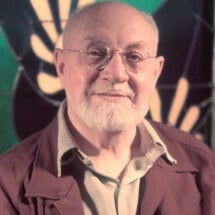
  • Henri Matisse

    Henri Matisse

    Henri Matisse stands as one of the most influential figures in modern art history. Born Henri-Émile-Benoît Matisse on December 31, 1869, in Le Cateau-Cambrésis, France, he initially studied law from 1887 to 1888 and worked as a legal clerk. His artistic path began unexpectedly in 1889 when, recovering from appendicitis, his mother gave him art supplies to pass the time. Discovering a natural talent, Matisse abandoned law by 1891 to pursue art full-time, studying at the Académie Julian and the École des Beaux Arts in Paris.

    Matisse became a central figure in the Fauvist movement, showcased at the 1905 Salon d’Automne in Paris. This revolutionary style featured bright, intense colors and bold brushstrokes freed from naturalistic constraints. After Fauvism disbanded in 1907, Matisse continued evolving, influenced by travels to Morocco in 1912 and 1913, and his 1917 move to Nice in southern France, where he eventually settled permanently. Throughout his career, he explored painting, drawing, sculpture, decoupage, and graphic works, creating commissioned pieces including a mural for the Barnes Foundation in Merion, Pennsylvania, and decorations for the Chapelle du Rosaire in Vence, France.

    Despite cancer diagnosis in 1941 and being wheelchair-bound after surgery, Matisse continued creating, particularly masterful paper cutouts. The Museum of Modern Art held a major retrospective in 1951, and the Musée Matisse opened in his hometown in 1952. Matisse died November 3, 1954, in Nice, leaving an enduring legacy celebrated by Park West Gallery and collectors worldwide.

  • Steve Hanks

    Steve Hanks

    Steve Hanks believed art came from a deep inner sense of direction, serving as a vehicle for portraying the emotions that arise from raising a family while always evoking positivity and comfort. Born in 1949 in San Diego, California, Hanks spent his youth surfing and playing tennis, developing a lasting connection to the Pacific Ocean that would later resurface in his artwork. At seventeen, his family moved to New Mexico, and after graduating high school, he attended the Academy of Fine Arts in San Francisco, excelling in commercial art and figure drawing. He later transferred to the California College of Arts and Crafts, earning a bachelor of fine arts degree.

    While working as a caretaker at a Campfire Girl’s camp in 1976, Hanks devoted four-and-a-half years to experimenting with oils, watercolor, pencil, and acrylics. After suffering an allergic reaction to oils, he switched to watercolors, eventually mastering the medium to echo the intensity and clarity of oil paints. Following his marriage to his wife Laura, with whom he had three daughters, Hanks found inspiration in capturing intimate moments of introspective solitude, focusing on the complexity of children and family life.

    Hanks called his style emotional realism, portraying intricate details while sometimes obscuring faces to let setting and body language convey emotion. Backlighting became a signature element, as he was fascinated by how light filtered through objects. Represented by Park West Gallery, Hanks also created stone lithographs by hand and was famous for producing fine art with Etch A Sketch toys. Despite being diagnosed with cancer, he never stopped painting. Hanks passed away at age sixty-six on April 22 in Albuquerque, New Mexico from cardiac arrest.

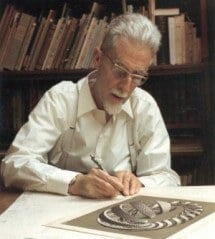
  • M.C. Escher

    M.C. Escher

    Maurits Cornelis Escher, known worldwide as M.C. Escher, was a Dutch printmaker whose mesmerizing works continue to captivate collectors. From 1922 to 1935, while living in Italy, he traveled extensively each spring and summer, sketching the countryside, hillside villages, and Roman architecture. Even in these early landscapes, Escher created enigmatic spatial effects by combining conflicting viewpoints—looking up and down simultaneously—and dramatizing them with vivid contrasts of black and white.

    After leaving Italy in 1935, Escher’s focus shifted to what he called “mental imagery.” A 1936 visit to the 14th century Alhambra palace in Granada, Spain, inspired him to develop “the regular division of the plane,” replacing Moorish tile patterns with interlocking recognizable figures. Metamorphosis—one shape transforming into something completely different—became a favorite theme starting in the 1920s. He also explored impossible architectural spaces and perspective games that challenged viewers’ perceptions.

    Throughout his lifetime, Escher created over 400 woodcuts, wood engravings, and lithographs, plus more than 2,000 drawings and sketches. The National Gallery of Art holds the preeminent collection of his work outside Holland, with more than 400 pieces. Escher died on March 27, 1972, at age 73. His visionary prints are represented by Park West Gallery.

  • Marc Courtemanche

    Marc Courtemanche

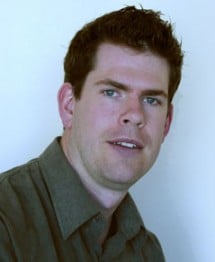
    Marc Courtemanche was born in 1971 in Sudbury, Ontario, a small mining town where he grew up working with his hands and spending time outdoors. His father recognized his three-dimensional talent early on and introduced him to woodcarving, a skill that would shape his future career as a sculptor.

    After high school, Courtemanche initially enrolled in Cambrian College’s heavy mechanics program before returning to his artistic roots. He completed his art diploma at Cambrian College, then earned his BFA from the Nova Scotia College of Art and Design. At NSCAD, he explored theory and conceptual practice, developing an appreciation for found objects and questioning his role as a sculptor. This inquiry led him to pursue a Masters program at the University of Regina in 2001, where he refined his technique and deepened his conceptual understanding of sculpture.

    Courtemanche currently lives in Regina with his wife, France, and their two children. He works at the university, occasionally teaching sculpture, while also serving as a technician and part-time assistant preparator at Mackenzie Art Gallery. His work is represented by Park West Gallery, bringing his thoughtful sculptural vision to collectors worldwide.

  • Paul Cézanne

    Paul Cézanne

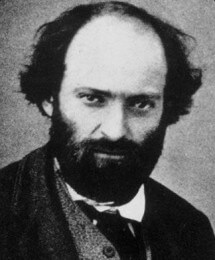
    Paul Cézanne was born on January 19, 1839, in Aix-en-Provence, France, and became one of the most influential figures in 20th century art. A pioneer of the Post-Impressionist movement, he inspired the development of Cubism and transformed how artists approached form and structure. Though his father, a successful banker, initially discouraged his artistic ambitions and pushed him toward law school, Cézanne eventually moved to Paris in 1861 to pursue his dream with his father’s financial support.

    Cézanne’s path to recognition was far from easy. After early rejections and periods of self-doubt, he found mentorship with Impressionist painter Camille Pissarro in the 1860s. In 1872, Cézanne moved to Pontoise with Hortense Fiquet, who would become his wife, and their son Paul. There he painted extensively with Pissarro, participating in the first Impressionist exhibition in 1874. However, Cézanne soon moved beyond Impressionism, seeking to create something more structured and lasting. His focus on geometric forms and spatial relationships laid the groundwork for Cubism, earning him the title from Pablo Picasso as “the father of us all.”

    After his first successful solo exhibition in 1895, Cézanne gained widespread acclaim. He continued working despite declining health until his death from pneumonia on October 22, 1906. Today, his works are exhibited in major collections worldwide, and he is represented by Park West Gallery.

  • Eugenio Cohaila

    Eugenio Cohaila

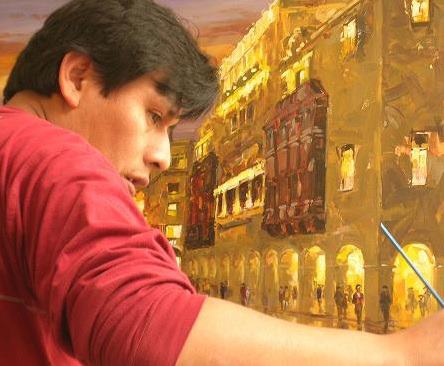
    Eugenio Cohaila finds endless inspiration in the energy of sprawling cities. Born near Tacna, Peru on a modest farm, he showed artistic talent from an early age, with teachers asking him to draw scenes during class field trips. Though his father wanted him to work the family farm, his mother recognized his passion and sent him to secondary school in Tacna at age seven, where he lived with his older sister while their mother visited weekly. In high school, he won an art competition a year before graduating, and his aunts encouraged him to pursue art professionally.

    Eugenio studied at the Beaux-Arts Superior School of Tacna, graduating with the second-highest grade in his class after five years. He later worked as an assistant making drawings for oil reproductions of Dutch Golden Age masters like Rembrandt and Vermeer, sharpening his techniques. In 1994, he pursued post-graduate studies in painting at the Escuela Nacional Superior Autónoma de Bellas Artes del Peru in Lima, where Peruvian artist Szyszlo’s colors and textural effects deeply influenced his work.

    Represented by Park West Gallery, Eugenio paints urban scenes in a wistful Impressionist style featuring vivid hues and radiant light. He depicts people as blurred subjects that blend harmoniously into their surroundings, capturing the rhythm of millions living together. His favorite subject is New York City, though he occasionally creates brightly-hued abstract landscapes that evoke dreamlike scenes.